5 Practical Steps to Deal With Slow Release Cycles

Published on 21 May 2026 by Zoia Baletska

Most teams notice slow release cycles long before they can explain them.
Features take longer to reach production than expected. Work sits in review queues for days. Releases become stressful enough that teams start avoiding them unless absolutely necessary. Eventually, delivery slows down to the point where planning becomes guesswork because nobody is confident about when work will actually ship.
The first instinct is usually to look at engineering speed. Teams assume developers need to work faster, automate more, or “become more Agile.” In reality, release cycles rarely slow down because people suddenly become less productive. More often, the delivery system itself accumulates friction over time. A few extra approvals here, a growing dependency there, increasingly complex releases, overloaded reviewers, unstable environments — individually manageable problems that gradually compound into a delivery pipeline nobody fully trusts anymore.
Improving release speed usually has less to do with rushing development and more to do with understanding where the system is quietly losing momentum.
1. Stop Treating the Release as a Single Event
One of the most common problems in slower organisations is that releases become isolated events instead of a continuous process. Teams accumulate changes for days or weeks, bundle them together, and then push everything through testing, approvals, deployment coordination, and monitoring at once.
This creates several side effects at the same time:
-
larger deployments become harder to validate
-
rollback risk increases
-
debugging production issues takes longer
-
teams become more cautious about releasing again
The cycle feeds itself. The more painful releases become, the less often teams want to perform them.
Smaller releases change the dynamics entirely. When changes are incremental, teams gain confidence faster because failures are easier to isolate and recover from. Release coordination becomes less dramatic, and production stops feeling like a high-risk environment.
This shift often requires operational changes rather than technical heroics. Teams need feature flagging, cleaner branching strategies, and more confidence in automated testing, but they also need cultural permission to release smaller increments instead of waiting for “complete” batches of work.
2. Find Where Work Actually Waits
Most delivery pipelines spend surprisingly little time in active development.
Work waits for clarification, reviews, approvals, QA validation, deployment windows, dependency updates, and stakeholder decisions. By the time teams calculate the full timeline, they often discover that coding itself was only a fraction of the cycle.
This is where many organisations struggle because traditional reporting tends to focus on throughput rather than waiting time. A board may show that tasks move steadily across statuses, while hiding the fact that tickets spend most of their life sitting idle.
Understanding release slowdowns requires visibility into flow:
-
where tickets stop moving
-
how long reviews take
-
how often does work get reopened
-
which dependencies repeatedly delay releases
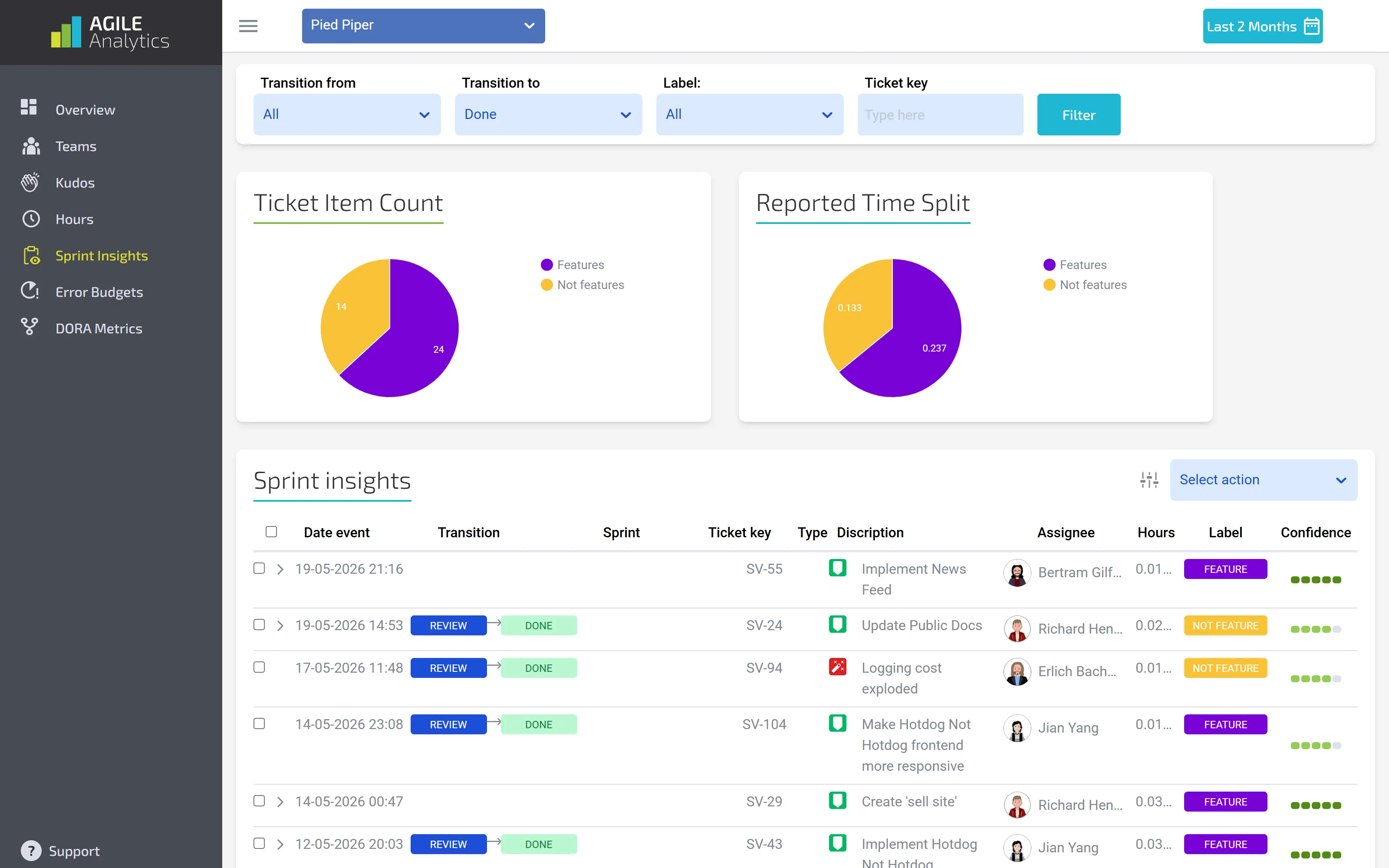
This kind of analysis is difficult to do manually once systems grow beyond a few teams. Platforms like Agile Analytics help surface those patterns automatically by connecting delivery systems, analysing workflow behaviour, and identifying where delivery friction accumulates over time.
Sometimes the biggest bottleneck is not development at all. It may be overloaded reviewers, unclear ownership, or operational processes that nobody questioned because they gradually became “normal.”
3. Reduce Coordination Overhead Before Adding More Process
When release cycles slow down, organisations often respond by introducing additional control layers:
-
more approvals
-
more planning meetings
-
more release coordination
-
more reporting
The intention is understandable. Larger systems feel risky, and additional governance appears to provide safety.
In practice, coordination overhead becomes one of the largest hidden contributors to delivery delays. Teams spend increasing amounts of time aligning with each other instead of moving work forward.
This tends to become especially visible in distributed architectures where releases depend on multiple services changing together. What originally looked like engineering complexity is often organisational complexity in disguise.
Teams with healthier release cycles usually simplify coordination wherever possible:
-
clearer ownership boundaries
-
fewer cross-team dependencies
-
independent deployment capabilities
-
standardised deployment workflows
These changes rarely look dramatic in isolation, but they reduce the amount of organisational friction required to ship software.
4. Treat Release Stability as a Delivery Metric
Slow release cycles are frequently caused by fear.
Teams hesitate to deploy because production incidents are expensive, difficult to diagnose, or politically painful. Even when nobody explicitly says “release less often,” behaviour gradually adapts around risk avoidance.
This is why deployment frequency alone can be misleading. Shipping more often only helps if teams trust the release process itself.
Tracking reliability alongside delivery metrics changes the conversation. Instead of measuring speed in isolation, teams can evaluate:
-
rollback frequency
-
production incident correlation
-
post-release defect rates
-
failed deployment recovery time
Over time, these signals reveal whether slower releases are caused by genuine instability or simply by accumulated caution.
Agile Analytics approaches this by combining delivery metrics with operational and workflow signals, allowing teams to correlate release patterns with reliability outcomes instead of treating them as separate concerns.
That context matters because many organisations accidentally optimise for the appearance of stability while making delivery progressively slower.
5. Accept That Process Debt Exists
Teams talk about technical debt constantly, but process debt tends to be ignored even though it accumulates in much the same way.
Every workaround, emergency approval flow, duplicated QA step, or manual deployment operation may solve an immediate problem while quietly making future releases harder.
The difficulty is that process debt rarely feels urgent on any individual day. It becomes visible only when delivery gradually slows across months or years.
Addressing it requires periodic examination of the delivery system itself:
-
Which steps still provide value?
-
Which approvals are mostly ceremonial?
-
Which parts of the release pipeline depend on tribal knowledge?
-
Where are teams compensating for broken workflows manually?
Organisations with consistently healthy release cycles usually revisit these questions continuously rather than waiting for a large transformation initiative.
Slow Releases Are Usually a System Problem
Teams often blame slow release cycles on execution, but the underlying causes are usually structural. Delivery slows as friction accumulates across planning, coordination, approvals, testing, and operational processes, making software release heavier than it needs to be.
Improving release speed rarely comes from pushing developers harder. More often, it comes from making the delivery system easier to move through.
That requires visibility into how work actually flows, where it slows down, and which patterns keep repeating. Once those signals become visible, improvements stop being based on assumptions and start becoming much more deliberate.
Supercharge your Software Delivery!
Implement DevOps with Agile Analytics
Implement Site Reliability with Agile Analytics
Implement Service Level Objectives with Agile Analytics
Implement DORA Metrics with Agile Analytics